
Happy hour is the busiest, loudest part of the day for many bars and restaurants. Orders stack up, glassware is everywhere, and a medical emergency is the last thing anyone expects. That’s exactly why a plan matters. If you manage a team in Halifax, choosing the best First Aid training you can find is one of the smartest prep steps before the after-work rush.
This guide is written for Nova Scotia. Rules and emergency systems in other places differ, so check your own.
Table of Contents
Why Is Happy Hour a Risky Time for Emergencies?
Because everything happens fast and at once.
Think about a typical rush. Doors open, the room fills, and staff move at full speed. Hot food and drinks are in motion. Glass is everywhere. Floors get wet. Stairs and tight corners get crowded. Everyone is focused on the next order, not on who might need help.
Most rushes pass without a problem. But when something does happen, a short delay can matter. A team that has practised what to do loses less time.
What Emergencies Can Happen in a Bar or Restaurant?
Most are small. A few aren’t. These are the ones to plan for:
- Choking. A guest eating fast, a child with a big bite, a staff member on a quick break.
- Burns and scalds. Hot oil, steam, boiling water and hot plates.
- Cuts. Knives, slicers, broken glass and can lids.
- Slips and falls. Spilled drinks, wet floors and crowded aisles.
- Allergic reactions. A guest or staff member reacting to something they ate or touched.
- Fainting. Heat, long shifts and skipped meals.
- Cardiac arrest. Rare in any one venue, but it can happen to a guest or a team member at any time.
Not all of these need CPR. But all of them go better when someone nearby stays calm and knows what to do.
Why Is It Hard to Spot an Emergency in a Loud Room?
Because noise and assumptions hide the signs.
It’s loud. Music, chatter and kitchen noise can cover a cry for help or a crash. A guest can slump at a table without anyone noticing for a moment.
People assume. In a bar, it’s easy to assume that someone who is slumped, slurring or unsteady has simply had too much to drink. But the signs of a medical emergency can look similar. As a general first aid principle, if someone is unresponsive or you’re not sure, treat it as a medical emergency, call 9-1-1 and follow the call taker’s instructions. Ask your instructor to confirm how to handle this in your venue.
Staff are spread out. Servers, bartenders, hosts and kitchen staff are in different places. Nobody has a view of the whole room.
A simple habit helps: ask staff to keep an eye on guests who go quiet or still, and to check on them.
Who Does What When Something Happens?
Decide before the rush, not during it. A short role plan works well:
- The caller. One person calls 9-1-1 and gives the exact address and what’s happening.
- The AED runner. Another person fetches the AED, if the venue has one.
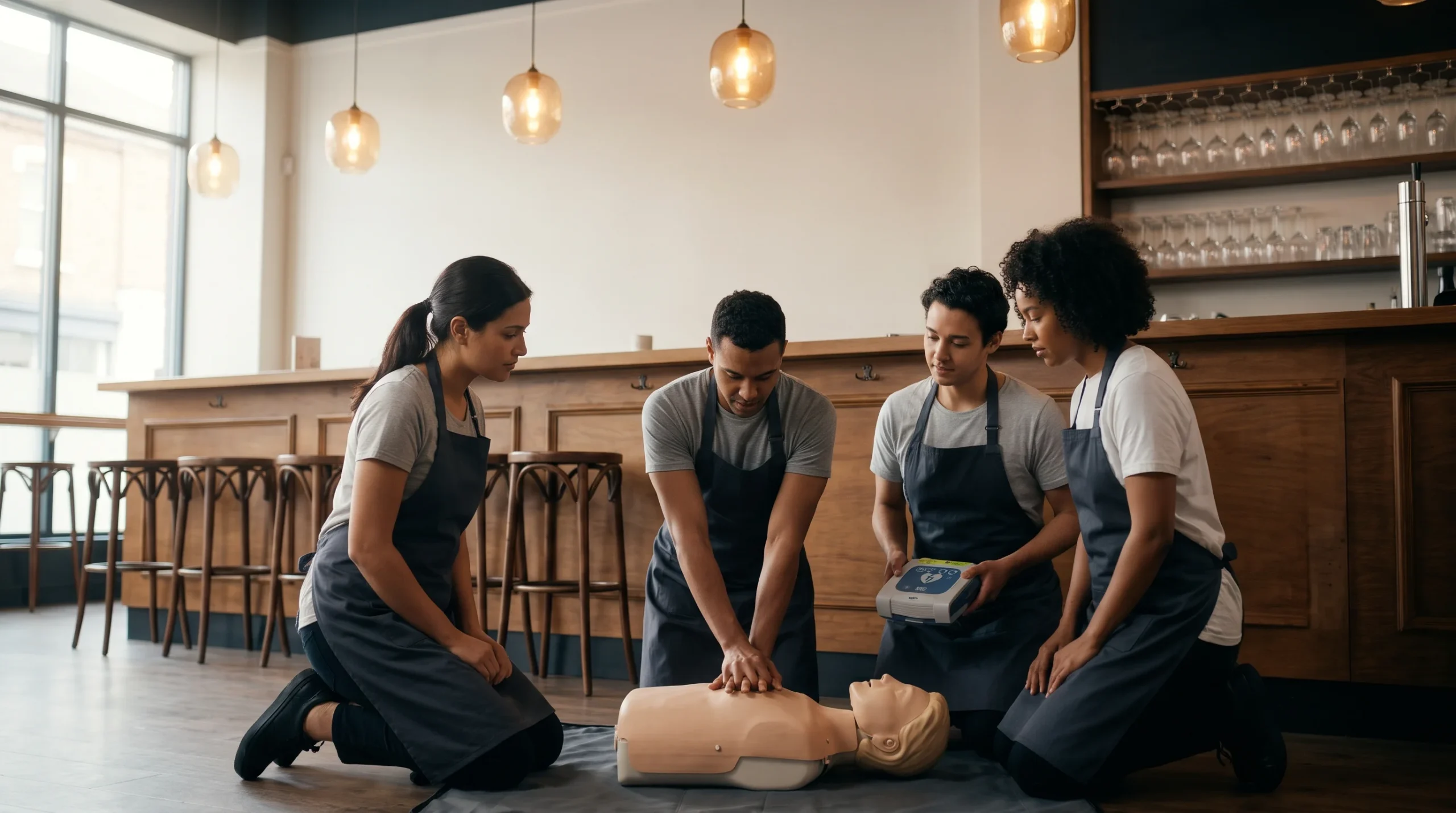
- The first aider. A trained person gives care and starts CPR if needed.
- The door person. Someone goes to the entrance to meet the ambulance and bring paramedics in.
- The crowd manager. Someone moves other guests back and keeps the area clear.
Say it out loud at a pre-shift meeting. A two-minute rehearsal makes the real thing much easier.
What Does a First Aid Course Teach?
According to Coast2Coast’s Halifax page, courses include hands-on skills testing with an AED trainer and cover life-saving skills such as minor injuries, cardiac arrest, choking, severe bleeding and stroke recognition. CPR/AED Level C covers adults, children and infants.
A few course facts from the page are worth knowing:
- Formats. You can take the course blended, with theory online at home and a day of in-person skills, or fully in person.
- Not fully online. The page says you can’t certify fully online, because skills testing happens in person.
- Course lengths. Intermediate/Standard First Aid with CPR/AED Level C is listed as a 16-hour course, and Basic/Emergency First Aid with CPR/AED Level C as an 8-hour course.
- Validity. First aid and CPR/AED Level C certificates are valid for three years. BLS, for healthcare providers, is valid for one year.
- Retake. The page lists a free skills practice retake within 90 days.
How Do You Choose the Best First Aid Training for a Team?
“Best” depends on your venue and your shifts. Use this checklist:
- Match the course to your needs. An 8-hour course and a 16-hour course are different commitments. Ask which one fits your venue and your employer’s or insurer’s expectations.
- Look for hands-on practice. You want time with mannequins and an AED trainer, with an instructor who gives feedback.
- Choose a format. Blended or fully in person, depending on your schedule.
- Check certificate details. Ask how long it’s valid and how renewal works.
- Plan for coverage. Train enough people that every shift, including closers and weekends, has someone certified.
- Ask about groups. The Halifax page lists private group training for eight or more. You can look at Coast2Coast First Aid group training to see how it works.
How Do You Fit Training Around Busy Shifts?
Plan it around your slowest days.
Stagger your people. Don’t send the whole team at once. Train one or two at a time so the venue stays open.
Use a blended format. Staff can finish the theory at home, then attend a day of in-person skills. That keeps time away from the floor to a minimum.
Consider a private session. If you have several staff, ask about training at your location, and confirm the minimum group size.
Put renewals in the calendar. A three-year certificate is easy to forget. Set a reminder well ahead of the expiry date.
What Should Your Pre-Shift Safety Check Cover?
Make this a two-minute routine, not a big project:
- First aid kit. Is it stocked and in a known place?
- AED. Does the team know where it is?
- Exits and access. Are routes clear for paramedics?
- Address and entrance. Can anyone give the exact location and the door to use?
- Floors. Are spills wiped and mats in place?
- Roles. Who’s on shift as the first aider tonight?
Why Does It Matter?
Because every minute counts. According to Heart & Stroke, about 60,000 cardiac arrests happen outside hospitals in Canada every year, and only one in 10 people survives. Nearly half happen to people under 65, so this isn’t only about older guests. It affects your team, too.
Heart & Stroke also says that doing CPR and using an AED can double a person’s chance of survival. Every minute without CPR or defibrillation lowers the odds by about 10%. In a busy venue, a trained team can make those first minutes count.
If you are looking for first aid training near Chebucto Road in west-end Halifax, including the Clayton Park, Fairview and Armdale areas, you may reach out to Coast2Coast First Aid & Aquatics in that area.
FAQs
Q: How long is a first aid and CPR/AED Level C certificate valid?
A: Coast2Coast’s Halifax page lists three years. BLS certification, for healthcare providers, is valid for one year.
Q: How long are the first aid courses in Halifax?
A: The page lists Intermediate/Standard First Aid with CPR/AED Level C as a 16-hour course, and Basic/Emergency First Aid with CPR/AED Level C as an 8-hour course.
Q: Can bar and restaurant staff get certified fully online?
A: No. The Halifax page says skills testing happens in person. You can do the theory online in a blended course, then attend an in-person skills session.
Q: What should I do if a guest collapses and isn’t breathing normally?
A: Call 9-1-1 and shout for an AED, start CPR right away, and use an AED as soon as one is available. Heart & Stroke stresses that you can’t hurt someone by trying, you can only help.
Q: Can a whole team train together?
A: The Halifax page lists private group training for eight or more. Ask about minimum group sizes and scheduling.

