


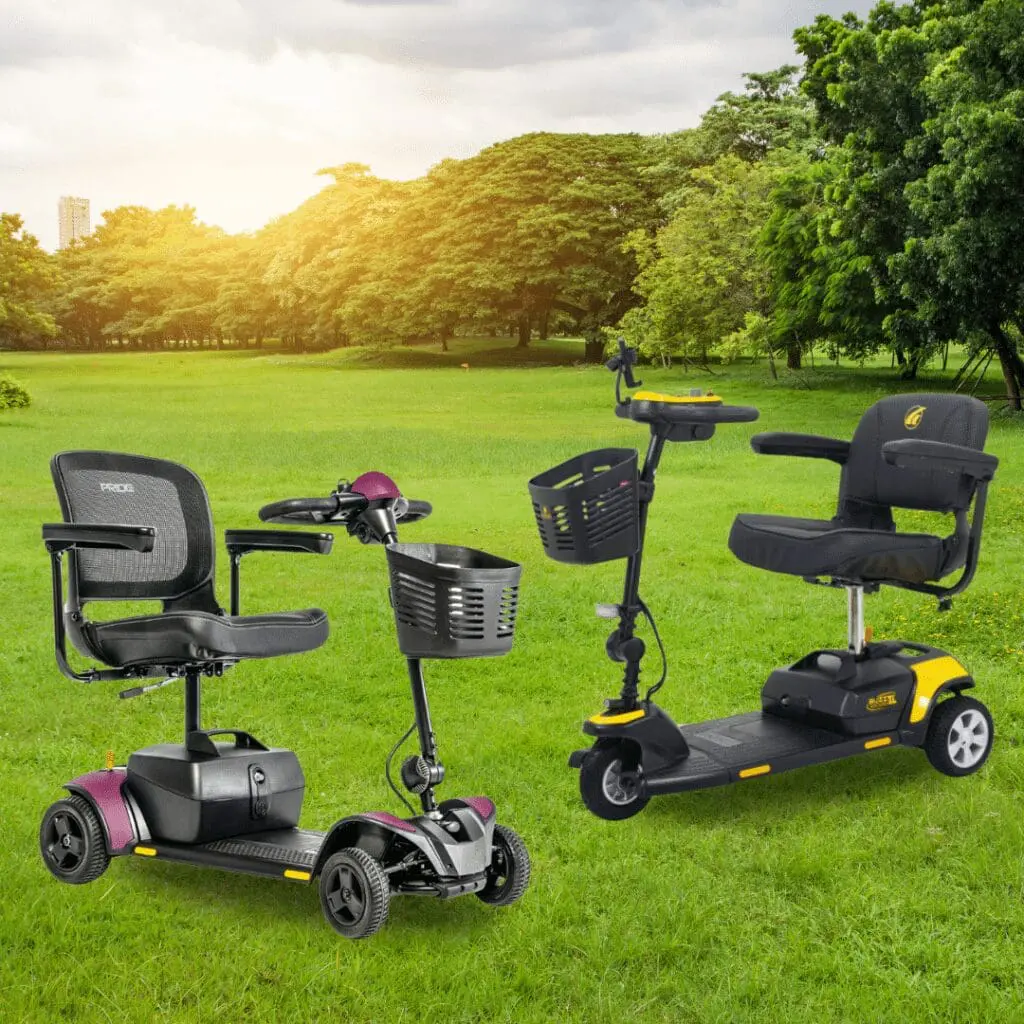
You have decided to buy a Pride mobility scooter, but now you face an important choice: should you get a three-wheel or four-wheel model? Both designs have their benefits, and the correct one depends on where you intend to ride, the space you need to turn, and what features are important to you. There are many Pride models in both layouts, and it may require a bit of comparison to find the correct fit.
When comparing real specifications to each other, you can see the differences between the two layouts in terms of turning radius, portability, stability, driving range, and comfort. You can then match these features to your travel habits and the spaces where you plan to use your scooter.
This article covers five key differences to help you choose the right Pride scooter for your daily needs.
1. Turning Radius and Indoor Maneuverability
Turning radius influences the ease of maneuvering a scooter along narrow corridors, door frames, and tight interiors. It is a measure of the minimum radius a scooter can turn. A smaller turning radius generally makes maneuvering in confined areas easier.
Three-wheel Pride mobility scooters generally have tighter turning radii than their four-wheel counterparts.
| Pride model | 3-wheel turning radius | 4-wheel turning radius |
| Go Go Ultra X | 36.5″ | 48.75″ |
| Go Go Sport | 36″ | 41.5″ |
| Revo 2.0 | 40″ | 52″ |
| Victory 10 | 42″ | 45.5″ |
| Maxima | 49″ | 53″ |
The Go Go Ultra X and Revo 2.0 have some of the biggest differences between the two layouts. Their three-wheel versions offer more room to maneuver in smaller rooms and crowded indoor areas.
But the number of wheels is not the only factor. An example is the four-wheel Go Go Endurance AL+ with a turning radius of 38.4 inches, which is smaller than some three-wheel models. Compare the specifications of individual scooters with the spaces where you plan to use them.
2. Size, Weight, and Portability for Travel
If you plan to transport your scooter in a car, consider its weight and how easily it can be taken apart. Many Pride travel scooters separate into smaller pieces, making them easier to load and store. Pay particular attention to the heaviest piece, as this is the part you or someone helping you will need to lift.
When comparing matching Pride models, the three-wheel versions have lighter heaviest pieces than their four-wheel counterparts.
| Pride model | 3-wheel heaviest piece | 4-wheel heaviest piece |
| Go Go Ultra X | 29.5 lbs | 36.2 lbs |
| Go Go Sport | 35 lbs | 44 lbs |
| Revo 2.0 | 48 lbs | 57 lbs |
| Victory 10 | 54.5 lbs | 61 lbs |
| Maxima | 130 lbs | 143.6 lbs |
These variations may influence the ease with which each model can be loaded into a car. The dimensions of its separate parts and the dismantling procedure are also important.
For example, both Go Go Ultra X versions separate into five pieces. The Go Go Super Portable offers a folding design that does not require seat removal and allows the scooter to stand upright when folded. After folding, it is also easier to move due to its towing handle.
Check the size of the folded or disassembled scooter and the weight of the heaviest piece before making a decision. Make sure the parts can fit your vehicle and available storage space.
3. Stability, Ground Clearance, and Outdoor Use
The way a scooter rides on various surfaces can be affected by the wheel layout, yet the overall design and features are of equal significance. Three-wheel models have a single front wheel, while four-wheel models have two front wheels and two rear wheels. When comparing the two layouts, take into account the surfaces and routes you frequent the most.
Ground clearance is the distance between the scooter’s lower frame and the ground. High clearance may be beneficial during riding over rough surfaces, ramps, and minor obstructions.
There are also Pride models with features intended to be used more outdoors. An example of this is the four-wheel Baja Bandit, which has a ground clearance of 4.5 inches, full LED lighting, a supplemental hand brake, and a full-suspension seat post. The Baja Wrangler 2 offers 8.25 inches of ground clearance, large air-filled tires, and front and rear Comfort-Trac suspension.
When comparing outdoor models, consider ground clearance, suspension, and tire design based on the conditions of your standard routes. The total size of the scooter also plays a role in determining where you intend to ride and store it.
4. Speed, Driving Range, and Battery Performance
Speed and driving range depend on the model, not simply on whether it has three or four wheels. Some Pride scooters are designed for shorter trips, while others offer higher speeds or longer stated ranges. Compare these specifications with how far and how often you plan to travel.
Here are the stated driving ranges of five matching models:
| Pride model | 3-wheel range | 4-wheel range |
| Go Go Ultra X | 8 miles | 8.9 miles |
| Go Go Sport | 15.9 miles | 14.5 miles |
| Revo 2.0 | 17.4 miles | 13 miles |
| Victory 10 | 15.5 miles | 16 miles |
| Maxima | 19.8 miles | 19.5 miles |
The figures show that neither layout consistently offers a longer range. The three-wheel Go Go Sport and Revo 2.0 have higher stated ranges, while the four-wheel Go Go Ultra X and Victory 10 offer slightly more distance per charge. The Maxima versions have nearly identical ranges.
Pride also offers four-wheel models with higher top speeds. The Victory LX Sport reaches a stated top speed of 8.6 mph, while the Pursuit 2 reaches 9.3 mph. Their stated ranges are 19.7 miles and up to 40 miles, respectively.
Battery type and configuration can also affect driving range. For example, the Go Go Endurance Li with CTS uses lithium batteries, while the Baja Bandit offers an optional dual lithium-ion battery configuration. Actual range may vary with rider weight, terrain, battery condition, and riding conditions.
5. Weight Capacity, Seating, and Ride Comfort
Weight capacity helps you identify which scooters can support your needs. Pride offers models with different limits, and matching three-wheel and four-wheel versions often have the same capacity.
| Pride model | 3-wheel capacity | 4-wheel capacity |
| Go Go Ultra X | 300 lbs | 300 lbs |
| Go Go Sport | 325 lbs | 325 lbs |
| Revo 2.0 | 400 lbs | 400 lbs |
| Victory 10 | 400 lbs | 400 lbs |
| Maxima | 500 lbs | 500 lbs |
Choose a model that comfortably supports your weight and any belongings you plan to carry. Seating is another important consideration, as the design and available adjustments affect your comfort during everyday use.
For example, both Revo 2.0 versions have comfort-focused seating and adjustable tillers. The Maxima models offer high-back seats with adjustable depth and limited recline, along with a wraparound delta tiller. These features give you more options for finding a comfortable riding position.
Conclusion
Choosing between three-wheel and four-wheel Pride scooters depends on which features best support your daily routine. Compare the turning radius, transport weight, range, and seating of individual models to find a suitable match.
Smaller details can also shape your experience. Storage baskets, USB ports, and easy-to-read battery gauges may make everyday trips more convenient. Consider which features you will use regularly, along with your travel and storage needs. Looking at the complete specifications rather than wheel layout alone can help you make a more suitable choice.

