


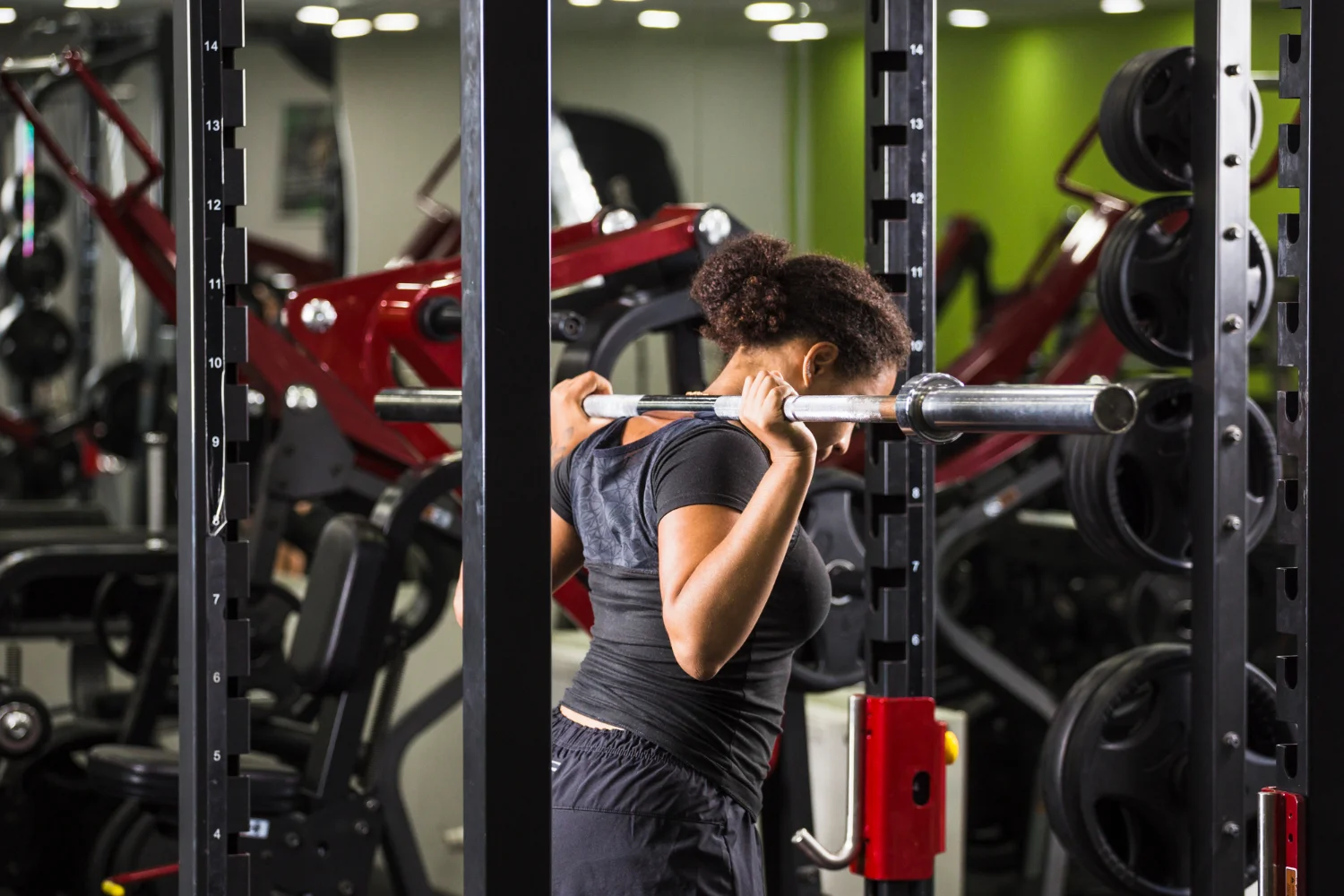
Walk into almost any well-equipped gym and you’ll probably find a Smith machine somewhere near the squat racks. Some lifters use it constantly. Others walk straight past it because they’ve heard free weights are always the better option.
The reality is less dramatic. A Smith machine and a free barbell simply solve different problems. The fixed bar path changes how you balance the load, set up exercises, and train without a spotter. In the right situation, those differences can be genuinely useful.
So, when does choosing a Smith machine actually make sense?
Table of Contents
When You’re Training Without a Spotter
Training alone changes the way many people approach heavy compound exercises. You might feel comfortable pressing or squatting a certain weight when someone is standing behind you, but hesitate when you’re on your own.
A Smith machine can make solo sessions easier to manage because the bar travels along rails and usually has multiple locking positions. Instead of having to guide a free bar back onto hooks when you’re tired, you can rotate or secure the bar at one of those positions.
That doesn’t mean you should ignore sensible loading or proper technique. Safety features aren’t an invitation to attempt weights you’re not ready for. They simply provide another layer of control.
For someone building a home gym where a training partner isn’t always available, that can be a particularly practical advantage.
When Balance Is Limiting the Exercise
Free-weight movements ask your body to control the weight in several directions at once. That’s part of what makes them valuable, but it can also become the limiting factor.
Imagine doing a split squat. Your legs may be capable of handling considerably more resistance, yet you keep wobbling as you try to maintain your position. Your set ends because you’ve lost balance rather than because the muscles you’re trying to train are actually tired.
A fixed bar changes that equation.
Because you don’t need to stabilize the bar in the same way, you can concentrate more closely on your stance, depth, and the muscles doing the work. This can be useful for exercises such as split squats, lunges, calf raises, and certain pressing movements.
There are plenty of Smith Machines by Flex Equipment designed around this controlled style of resistance training, including configurations that combine the Smith mechanism with other training stations.
When You Want to Push a Muscle Closer to Fatigue
Sometimes stability isn’t the goal of an exercise. You simply want to challenge a particular muscle.
Take a squat variation focused heavily on the quadriceps. With a free bar, you have to think about the bar position, your balance, and keeping the load over a stable base. On a Smith machine, the rail handles part of the stabilisation requirement.
That can let you pay more attention to the target muscles.
The same principle can apply to presses. Once you’re comfortable with your setup, you aren’t spending as much effort controlling sideways movement of the bar. That may make it easier to focus on controlled repetitions as fatigue builds.
Bodybuilders have used machines for exactly this reason for decades. Not every exercise needs to test every physical quality simultaneously.
When Your Gym Has Limited Space
Space becomes a serious consideration when you’re setting up a home or garage gym.
A traditional strength setup might require a rack, barbell, weight plates, bench, cable station, and several other pieces of equipment. Once you start adding everything together, a supposedly spacious garage can become crowded surprisingly quickly.
Some Smith machines are incorporated into larger multi-function trainers. Depending on the design, one footprint may provide access to Smith exercises, cable movements, pull-ups, and other resistance exercises.
That can make more sense than filling the room with several separate machines.
Before buying anything, measure the actual training area rather than just the floor space occupied by the equipment. You’ll also need room to load plates, move around the machine, adjust attachments, and position a bench.
Ceiling height matters too, especially if the unit includes pull-up handles.
When You Want Repeatable Movement
One underrated advantage of a guided bar is consistency.
Because the bar follows the same track on every repetition, it’s easier to recreate your setup from one workout to another. You can note your foot position, bench position, bar height, and load, then return to almost exactly the same arrangement next time.
That can be helpful when you’re tracking progress.
Suppose you’re doing an incline press and want to know whether you’ve actually become stronger over six weeks. If your setup keeps changing, the comparison becomes less useful. A repeatable setup removes some of those variables.
Of course, consistency only helps if the position suits you in the first place.
The Fixed Path Isn’t Automatically Better
The feature that makes a Smith machine useful is also its biggest limitation.
A free bar can move according to the path your body naturally creates. A Smith bar follows the machine’s predetermined path. Depending on the machine and the exercise, that movement may feel comfortable or awkward.
This is why copying your free-weight technique exactly isn’t always the best approach.
Your foot position during a Smith squat, for example, may need to differ from your position during a barbell squat. Bench placement also matters during presses. Small adjustments can dramatically change how a movement feels.
If an exercise consistently causes discomfort, don’t force yourself to fit the machine.
Smith Machine or Free Weights?
There’s no need to turn this into an either-or decision.
Free weights are useful when you want to practise controlling a load through space and challenge stabilising muscles alongside the main movers. Smith machines are useful when you want greater external stability, a repeatable bar path, or a setup that works well for solo training.
A sensible gym can include both.
You might perform free-weight squats as your main strength movement, then use a Smith machine for split squats or calf raises afterward. On another day, you might bench with a barbell and use the Smith machine for a higher-repetition incline press.
The equipment doesn’t decide the quality of the workout. How you use it does.
What to Check Before Choosing a Smith Machine
If you’re considering one for your own training space, start with the basics.
Check the machine’s dimensions and available training area. Look at how the bar locks and where the safety stops can be positioned. Consider the exercises you actually perform rather than being distracted by features you’re unlikely to use.
If you’re looking at an all-in-one model, examine the additional stations carefully. A cable system, pull-up station, or storage solution can be valuable when you’ll genuinely use it. Otherwise, you’re paying for equipment that mostly takes up space.
Also think about who will use the machine. Adjustable safety positions and flexible exercise options become more important when several people of different heights train on the same setup.
Also Read :Why More Families Are Building a Second Home in Their Own Backyard
Choosing the Tool That Fits Your Training
Smith machines don’t need to replace barbells, dumbbells, or other resistance equipment to earn their place in a gym. Their value comes from providing something different: a guided bar path that reduces some of the stability demands of lifting.
That can be useful when you’re training alone, trying to focus on a specific muscle, working with limited space, or simply looking for more exercise options.
Instead of asking whether Smith machines are better than free weights, ask a more practical question: what do you need the equipment to help you do? Once you know the answer, choosing between a fixed bar and a free one becomes much easier.

