
Drunk driving continues to be a huge problem in America. According to NHTSA statistics, crashes involving an alcohol-impaired driver accounted for 11,904 fatalities in 2024. These cases accounted for about 30 percent of the total fatalities recorded from crashes that year.
To spot impairment, officers rely on a range of tests. Some tests, like eye tracking, look for involuntary eye movement. More challenging ones assess balancing on one foot or walking in a straight line.
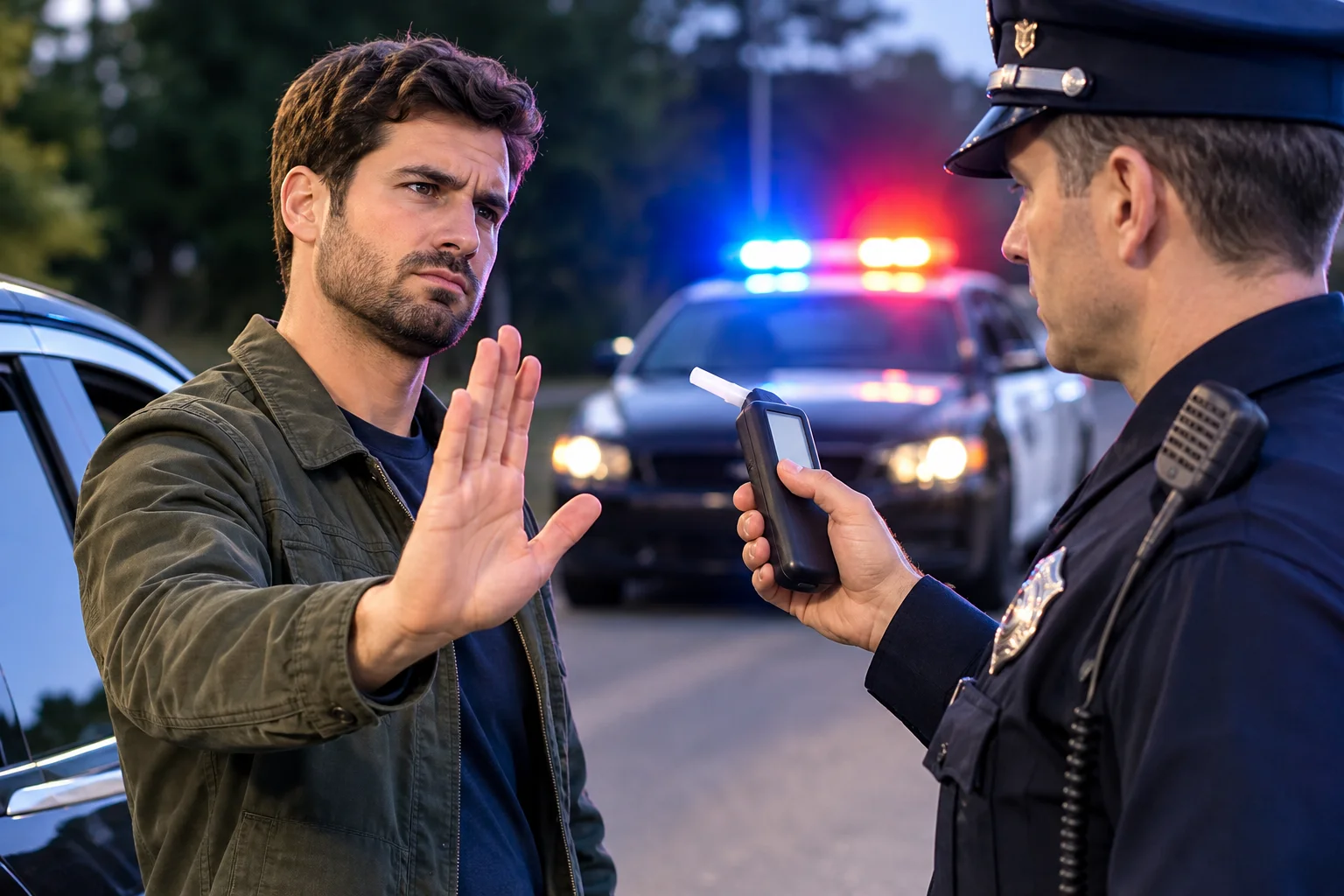
Can you refuse standardized field sobriety tests? As with anything involving the US legal system, the laws around field sobriety testing are complicated. Field sobriety tests can be refused in any state, but refusal can be used against the driver in some states. Each state has separate laws for testing a driver’s breath or blood. Turning down those procedures often carries much harsher consequences.
A field sobriety test is different from a chemical test, such as a breath or blood test, which may be governed by the laws of implied consent and have their own penalties for refusal.
Driving laws vary slightly from state to state, so the legal rights of a driver to refuse certain tests in traffic stops also differ. Understanding how a state handles a refusal of a sobriety test can help a driver make a decision.
Table of Contents
Two Different Tests Get Confused Constantly
Much of what is written on this topic treats roadside tests and the chemical test as one thing, even though they are separate procedures with different purposes and different consequences.
Roadside tests come first, before any arrest. They include standing on one leg, walking a straight line, and following an officer’s finger with the eyes. An officer observes and scores a driver’s performance on these physical tasks, and the results help establish probable cause for an arrest.
The chemical test comes after an arrest. It measures the alcohol concentration in a driver’s breath or blood and produces a numerical result. With this test, the consent to be tested is implicit when an individual applies for and accepts a driver’s license. The license suspension linked with the chemical test results is a penalty separate from the suspension linked with a driver’s refusal to submit to the chemical test.
The Tests Measure Divided Attention, Not Guilt
Understanding the design principles explains why these tests work and why they don’t.
In the walk-and-turn and one-leg stand, the person being tested must focus on multiple tasks at once. Examples include standing still and, at the same time, listening to the officer. A driver may also be asked to keep their heels and toes together while walking a straight line. They will also be asked to count out loud as they walk. All of these require dividing attention, an activity impacted by alcohol well before gross motor skills like walking. Testing for a person’s ability to divide attention is a more effective method of detecting driving under the influence than waiting to see someone’s ability to walk.
Other variables may have a deleterious effect on these tests, like the aging process, weight, diseases affecting the inner ear, or any injuries that may have occurred to the back, ankles, or knees. Using drugs can have similar effects on test performance. Having an officer shout stressful instructions from behind flashing lights will only compound a driver’s test performance. Things like having a slope on the roadway, gravel surfaces, and improper footwear can ruin the tests too.
These tests apply only when a driver is stopped and available for testing. In hit and run cases, where a driver leaves the scene, there is often no roadside stop and no field testing, so the case depends on other evidence. A driver facing that situation in California may consult a West Covina hit & run DUI lawyer to review how that evidence was gathered.
Two States That Answer the Question in Writing
Most states treat the roadside battery as a request rather than a command, and two statutes show how the question gets written down.
California puts the handheld roadside breath device inside the same category as the physical tests. Its code states that a preliminary alcohol screening test is a field sobriety test and may be used by an officer as a further investigative tool. It requires the officer to advise most drivers of the right to refuse it. The statute treats a request as something a driver can decline after being told so.
Meanwhile, North Carolina takes a different statutory approach. Its roadside screening provision allows an officer with reasonable grounds to require a test. The state also says that a driver’s refusal to submit may be used by the officer, is admissible in court, and may be used to determine whether reasonable grounds exist to believe an offense was committed. It attaches consequences in the form of evidence rather than revocation.
Refusing a roadside breath test is an option in most states. But keep in mind that doing so can carry consequences, even if there is no blood alcohol limit violated.
Also Read : Host Outdoor Gatherings Without the Last-Minute Panic
Declining Does Not Stop the End
In truth, refusing a roadside sobriety test can carry consequences. These ramifications of refusing further contradict the view that a person risks little when rejecting a roadside test.
Even in the absence of a chemical test result, officers have options. They can build a case against a driver based on their observations. This evidence could include the initial reasons for pulling a driver over, driving behavior observed prior to the stop, odor of alcohol on the driver, speech irregularities, physical features, the driver’s ability to remain steady after leaving the vehicle, and comments made during the interaction with the officer. Such observations are most commonly the basis of building probable cause for an arrest.
So a refusal removes one category of evidence rather than ending the encounter. What it removes happens to be the category most open to challenge later, since the tests are scored by a person applying standardized criteria under conditions that were never standardized.
Refusing the chemical test after arrest is a separate decision with separate consequences. Those rules vary by state, and some carry criminal penalties of their own.
NHTSA’s 1998 San Diego validation study put the accuracy of the eye test, walk-and-turn, and one-leg stand at about 88, 79, and 83 percent, respectively. Those numbers are good enough to be useful and nowhere near good enough to be conclusive.

